TikTok Ads & Influencer Marketing Malaysia: 2026 Playbook


This post covers the paid and creator side of TikTok marketing in Malaysia — ad formats, influencer selection, and TikTok Shop strategy. If you are new to TikTok and have not yet built your organic content foundation, start with the TikTok Marketing Malaysia Strategy Guide first.
TikTok Ads Malaysia: Formats and When to Use Them
Organic reach on TikTok is strong, but TikTok ads in Malaysia allow you to scale what is already working and reach audiences beyond your existing followers. TikTok ads reached the equivalent of 86.8% of Malaysia's entire internet user base in late 2025 — making it one of the highest ad reach platforms available to Malaysian marketers.
📎 Source: DataReportal Digital 2026: Malaysia
TikTok organizes every campaign across three levels — Campaign (objective) → Ad Group (targeting, budget, placement) → Ad (creative). Your objective determines which formats are available.
How to Start With TikTok Ads in Malaysia
The most common mistake Malaysian brands make with TikTok ads is going straight to paid without proving organic first. Spending ad budget on content that has not demonstrated organic appeal is expensive trial and error.
The recommended approach for brands new to TikTok ads in Malaysia:
Run organic content consistently for 30–60 days
Identify your two or three best-performing organic posts by watch time and engagement
Run Spark Ads on those posts to a targeted audience that mirrors your existing engaged viewers
Review results after 14 days — ROAS, click-through rate, and conversion — before scaling budget
This approach ensures you are putting money behind content that has already proven it resonates with a real Malaysian audience. It significantly reduces wasted spend compared to launching paid campaigns from scratch.
TikTok Influencer Marketing Malaysia
TikTok influencer marketing in Malaysia is one of the most cost-effective channels for building brand credibility and reaching new audiences — when you work with the right creators.
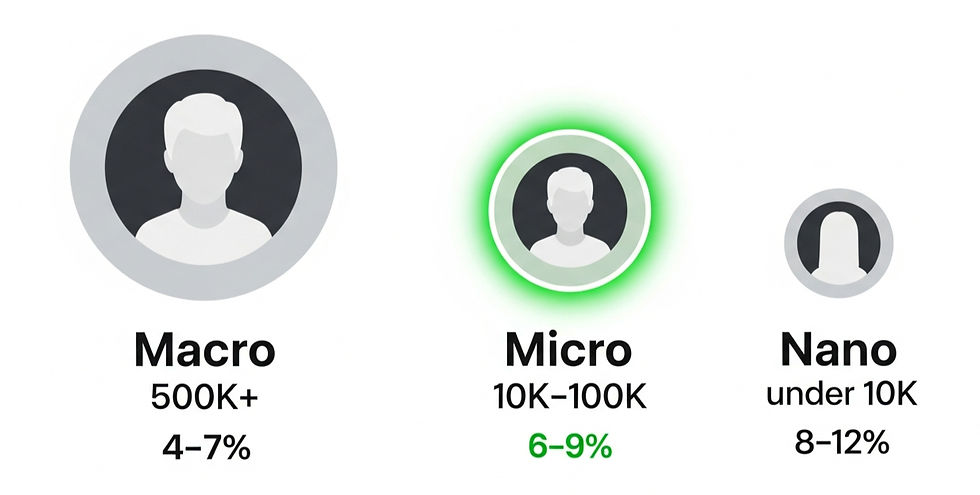
The data strongly supports prioritizing engagement over follower count. Micro-influencers on TikTok achieve engagement rates of 6–9%, while nano-influencers reach 8–12%. By comparison, macro-influencers typically deliver 4–7%. TikTok influencer campaigns in Malaysia generate an average engagement rate of 6.4% — significantly higher than Instagram's 3.1% average.
📎 Sources: InfluenceFlow — Influencer Marketing Metrics 2026 · Zebracat — Influencer Marketing Statistics 2025
Engagement rates across Southeast Asia average 6.1% — notably higher than North America's 3.4% — making Malaysian creator partnerships particularly valuable relative to global benchmarks.
73% of brands globally now favour micro and mid-tier creators over celebrity and macro-influencer partnerships. Brands achieve an average return of $5.78 for every dollar spent on influencer marketing, with top-performing campaigns reaching $11–$18 ROI per dollar.

What to look for when evaluating TikTok influencers in Malaysia:
Engagement rate — likes, comments, and shares as a percentage of views. Anything consistently above 5% on TikTok is strong.
Audience location — confirm their audience is actually in Malaysia, not primarily from Indonesia, Singapore, or outside the region. Ask for their TikTok analytics screenshot.
Content authenticity — do their sponsored posts feel native to their usual content, or do they feel like obvious paid placements?
Comment quality — genuine engagement shows in comments. Generic one-word comments or suspiciously uniform responses are a red flag for purchased engagement.
Category relevance — a lifestyle creator with 30,000 engaged followers in your product category will almost always outperform a general creator with 300,000 passive followers.
TikTok Shop Malaysia: Turning Views Into Sales
TikTok Shop has transformed TikTok from a brand awareness platform into a full-funnel commerce channel. Malaysian consumers can now discover, evaluate, and purchase a product without ever leaving the app — and this is reshaping how brands think about e-commerce.
In 2025 alone, TikTok recorded over 7.2 million live broadcasts in Malaysia, with over 4.5 million content creators generating income through TikTok Live — including through direct product sales on the platform.
For brands selling physical products in Malaysia, TikTok Shop should be a priority channel in 2026. Live selling in particular shows exceptional conversion rates — especially in F&B, beauty, fashion, and consumer electronics. The brands winning on TikTok Shop Malaysia are those treating live selling as a consistent weekly operation rather than a one-off promotional event.
The key to sustainable TikTok Shop performance is integrating it tightly with your organic content and influencer strategy. Every product video drives viewers to your shop. Every creator partnership includes a TikTok Shop affiliate link. Every live session converts real-time viewers directly. These three channels — organic, influencer, live — working together produce compounding results that no single channel achieves alone.

FAQ
How much do TikTok influencers charge in Malaysia?
TikTok influencer fees in Malaysia vary significantly by creator tier. Nano-influencers (under 10,000 followers) typically charge RM300–800 per post. Micro-influencers (10,000–100,000 followers) range from RM800–3,000 per post. Mid-tier creators (100,000–500,000 followers) typically start from RM3,000–8,000 per post. Always negotiate based on engagement rate and audience relevance, not follower count alone.
What is the minimum budget for TikTok ads in Malaysia?
TikTok's minimum campaign budget is approximately RM50 per day, with a minimum ad group budget of RM20 per day. For meaningful reach and enough data to optimize, a realistic starting budget for Malaysian brands is RM5,000–8,000 per month. Spark Ads on already-performing organic content can stretch this budget further than cold In-Feed campaigns.
Should I run TikTok ads or invest in influencer marketing first?
For most Malaysian brands starting out, influencer marketing delivers faster credibility-building at lower cost than TikTok ads. A well-matched micro-influencer post can reach a highly relevant audience with authentic endorsement that paid ads cannot replicate. The ideal approach is to use influencer content first to generate organic traction, then amplify top-performing creator posts using Spark Ads — combining both channels for maximum efficiency.
Yew Fei Leong is a marketing consultant based in Kuala Lumpur with over 20 years of experience in omnichannel marketing across Malaysia and Southeast Asia. Work with me →


Comments